STEM Assessment in the Digital Era: How Möbius Transforms Evaluation in Higher Education
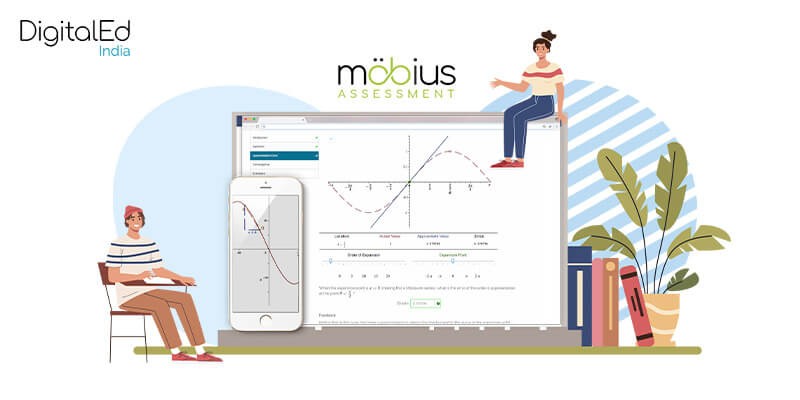
STEM assessment has evolved far beyond static quizzes and basic multiple-choice tests. Institutions today need online assessment platforms that can evaluate conceptual understanding, discourage malpractice, scale across cohorts, and still provide meaningful feedback to learners.
This is where Möbius Assessment stands apart.
Designed specifically for mathematics, engineering, and science disciplines, Möbius enables STEM assessment that mirrors how students actually think, solve, and express STEM problems. It allows educators to assess learning with precision, integrity, and pedagogical depth—whether in classrooms, hybrid environments, or fully remote settings.
What Is Möbius Assessment in Modern STEM Assessment?
Möbius Assessment is a purpose-built digital assessment platform for STEM education. It supports mathematically rich, computation-heavy, and logic-driven questions that conventional learning management systems struggle to handle.
Unlike generic assessment tools, Möbius understands mathematics symbolically. It evaluates equivalence, not just final answers. This allows instructors to design assessments that truly measure problem-solving ability rather than memorization.
At its core, Möbius Assessment enables:
- Algorithmically randomized questions for every learner
- Embedded and adaptive questions within learning content
- Automatic grading of complex STEM responses
- Secure delivery for high-stakes examinations
Together, these capabilities redefine how online assessment platforms can be used in STEM education.
Why Scalable STEM Assessment Matters in Higher Education
STEM disciplines demand precision, variation, and reasoning. Asking the same static question to hundreds of students often leads to answer sharing and surface-level learning.
Algorithmic online assessment addresses this challenge by dynamically generating unique problem instances from a single question template. Each student receives a different version of the same conceptual problem, with altered variables, datasets, or parameters.
This approach:
- Preserves academic integrity
- Encourages independent problem-solving
- Enables repeated practice without repetition
- Supports fair evaluation at scale
Möbius Assessment was built with algorithmic assessment as a foundational principle, not an add-on.
For educators looking to modernize evaluation, this approach aligns closely with the principles outlined in discussions on smart assessment and automated grading in STEM education.
Embedded Questions That Strengthen STEM Assessment
Assessment does not need to be separate from instruction.
Möbius allows instructors to embed questions directly within learning materials. These embedded questions can appear inside:
- Video lectures
- Reading content
- Worked examples
- Practice modules
Students engage with problems at the exact moment a concept is introduced. Immediate feedback helps them correct misunderstandings before they become gaps.
This integration transforms assessments from judgment tools into learning instruments—a key requirement for effective online assessment platforms in higher education.
Adaptive Questions for Personalized STEM Assessment
Not all learners progress at the same pace.
Möbius supports adaptive questioning, where the next problem adjusts based on a student’s response. If a learner struggles, Möbius can present scaffolded questions. If they excel, the platform can increase complexity.
Adaptive assessment:
- Identifies conceptual weaknesses early
- Prevents disengagement
- Supports mastery-based learning
When combined with STEM assessment, adaptive questions create a personalized evaluation pathway without increasing faculty workload.
Entering Mathematical Expressions Naturally
One of Möbius Assessment’s most powerful features is how it handles mathematical input.
Students can enter expressions exactly as they would write them on paper. Fractions, exponents, integrals, derivatives, and symbolic expressions are all supported.
More importantly, Möbius understands equivalence.
For example, different but mathematically identical answers—such as alternate trigonometric forms or equivalent derivatives—are graded correctly. This capability ensures fairness and accuracy, especially in advanced mathematics and engineering courses.
This symbolic intelligence sets Möbius apart from standard online assessment platforms that rely solely on predefined answer keys.
Automated Grading in Large-Scale STEM Assessment
Manual grading of STEM assessments is time-consuming and inconsistent at scale.
Möbius Assessment offers over 50 automatically graded question types, including numerical, symbolic, graphical, and algorithmic problems. Grades are generated instantly, while maintaining mathematical rigor.
Students receive:
- Immediate results
- Step-specific feedback
- Clear identification of errors
Instructors gain:
- Centralized gradebooks
- Item-level performance insights
- Options for manual review where required
This balance between automation and control reflects the broader shift toward automating administrative tasks in STEM education while preserving academic quality.
Secure Exams and Academic Integrity in STEM Assessment
High-stakes assessments demand robust security.
Möbius Assessment includes a secure browser environment that restricts access to external websites, applications, and system tools during exams. This ensures that students remain within the assessment interface throughout the test duration.
For institutions conducting online or hybrid exams, Möbius integrates seamlessly with remote proctoring workflows. These capabilities align with best practices discussed in modern remote proctoring solutions for STEM education.
Together, secure delivery and STEM assessment significantly reduce the risk of malpractice.
Analytics-Driven Insights for Continuous STEM Assessment Improvement
Assessment data is only valuable if it leads to insight.
Möbius provides detailed analytics that help educators understand how students engage with content and where they struggle. Instructors can analyze:
- Question-level performance
- Common misconceptions
- Time spent per problem
- Attempts and progression patterns
These insights support informed instructional decisions and continuous course improvement. Such analytics-driven teaching approaches are central to empowering educators through student analytics.
Using Möbius Assessment in Engineering and Science Courses
Engineering and science assessments often involve multi-step reasoning, variable-driven problems, and symbolic computation.
Möbius Assessment is particularly effective for:
- Engineering mathematics
- Physics and mechanics
- Chemical calculations
- Control systems and signal processing
By enabling STEM assessment, instructors can test applied understanding rather than rote recall. This approach prepares students for real-world problem-solving, not just examinations.
The effectiveness of this model is further explored in discussions on smart math assessments with Möbius.
Seamless LMS Integration
Möbius can be used as a standalone platform or integrated into existing learning management systems.
When integrated, students access assessments through their familiar LMS interface. Grades sync automatically, eliminating duplication of effort for instructors.
This integration addresses a critical gap: while LMS platforms manage content and administration well, they often fall short in delivering advanced STEM assessments. Möbius fills this gap with technically sophisticated evaluation tools.
The Future of Scalable and Authentic STEM Assessment
The future of STEM education depends on assessments that are fair, scalable, and meaningful.
Möbius Assessment supports this future by combining:
- Algorithmic online assessment for integrity and scale
- Embedded and adaptive questions for learning alignment
- Secure delivery for exams
- Automated grading with deep analytics
These capabilities position Möbius not just as an assessment tool, but as a comprehensive evaluation ecosystem for STEM education.
For institutions exploring innovative assessment strategies, this approach represents a leap toward modern STEM learning and evaluation.
Conclusion
Assessment shapes how students learn.
By adopting Möbius Assessment, institutions move beyond static testing toward STEM assessment that measures understanding, supports integrity, and improves learning outcomes.
For educators seeking reliable, scalable, and pedagogically sound online assessment platforms, Möbius offers a proven solution designed specifically for the complexities of STEM education.
To explore how Möbius can be implemented for your courses or institution, Schedule a demo with the DigitalEd team.