PHYGITAL Learning Implementation: Crafting the Future of STEM Education
Introduction
Education systems across the world are undergoing a structural transformation. Traditional classroom-based instruction alone is no longer sufficient, while fully digital learning models often struggle with engagement, equity, and learning continuity. This gap has given rise to a blended approach that brings together physical classroom experiences and digital technologies into a single, cohesive learning ecosystem.
This integrated model is not designed to replace teachers or physical institutions. Instead, it strengthens them by extending learning beyond classroom walls and enabling continuous practice, feedback, and reflection. For STEM education in particular, this approach is highly effective, as science, technology, engineering, and mathematics require strong conceptual understanding, hands-on problem-solving, and iterative learning.
Within this learning environment, students interact with concepts through in-person classroom instruction and laboratory work, while digital tools reinforce understanding through simulations, assessments, and personalized feedback. The seamless interaction between physical and digital spaces helps bridge the long-standing gap between theoretical knowledge and real-world application.
To understand the foundational role of this approach, it is important to examine how Phygital Learning is bridging the digital divide and creating equitable access to quality STEM education across diverse learning environments.
Challenges of Phygital Learning in STEM Education
While Phygital Learning offers tremendous potential, its implementation is not without challenges. Understanding these obstacles is crucial for institutions aiming to create effective and sustainable learning ecosystems.
1. Infrastructure Limitations
Reliable internet connectivity and access to devices are foundational for Phygital Learning. Many schools and institutions, especially in semi-urban and rural areas, face challenges in providing stable networks, modern computers, or smart devices for all students. Without this infrastructure, even the best-designed Phygital Learning programs may fail to reach their full potential.
2. Educator Readiness
Teachers are central to Phygital Learning. However, many educators may lack sufficient training or confidence in using digital tools alongside traditional teaching methods. Effective integration requires continuous professional development programs to ensure teachers can deliver interactive, technology-enhanced STEM lessons.
3. Digital Equity
Even when infrastructure exists, differences in students’ home environments, access to devices, and digital literacy can create inequities. Ensuring that every student benefits equally from Phygital Learning remains a major challenge.
4. Content Development Complexity
Creating meaningful and interactive digital content for STEM education requires expertise in pedagogy, technology, and subject matter. Designing simulations, interactive quizzes, and adaptive modules that align with learning objectives is resource-intensive and demands ongoing updates.
5. Assessment and Academic Integrity
While digital assessment and automated grading can streamline evaluation, maintaining fairness and integrity in online environments can be challenging. Institutions often rely on remote proctoring solutions to prevent malpractice, but implementing these systems effectively requires careful planning and support.
6. Student Engagement and Motivation
Blending physical and digital learning can sometimes overwhelm students. Ensuring consistent engagement requires well-structured content, interactive exercises, and real-time feedback mechanisms. Without these, students may disengage or struggle to adapt to new learning modalities.
Despite these challenges, Phygital Learning remains a transformative approach for STEM education. By addressing infrastructure gaps, supporting educators, designing accessible content, and leveraging technology effectively, institutions can overcome these hurdles and provide a seamless, inclusive learning experience.
PHYGITAL Learning and the Changing Landscape of STEM Education
STEM education has always required more than passive learning. Students must visualize abstract concepts, experiment with variables, and apply mathematical reasoning to real-world problems. However, traditional classroom settings often struggle to provide sufficient time, resources, and individualized attention.
Phygital Learning addresses these challenges by extending learning beyond fixed schedules. Students are no longer restricted to learning only during classroom hours. Instead, they can revisit lessons, practice problems, and explore simulations through digital platforms while still benefiting from in-person guidance.
This hybrid approach improves retention and conceptual understanding. It also supports continuity when physical access is disrupted, ensuring that STEM education remains uninterrupted.
Equity is another critical factor. Students from different regions, institutions, and socio-economic backgrounds often experience uneven access to quality instruction. Phygital Learning helps reduce this imbalance by standardizing access to high-quality digital resources while preserving the human element of classroom teaching.
Inclusive design further strengthens this model. Institutions adopting Phygital Learning increasingly prioritize accessibility in education to ensure that STEM learning resources are usable by students with diverse abilities, learning styles, and technological constraints.
The 8 Cs of Phygital Learning: A Structured Framework for STEM Success
Effective Phygital Learning does not happen by chance. It follows a structured framework that ensures consistency, engagement, and measurable outcomes. One such widely adopted model is the 8 Cs of Phygital Learning
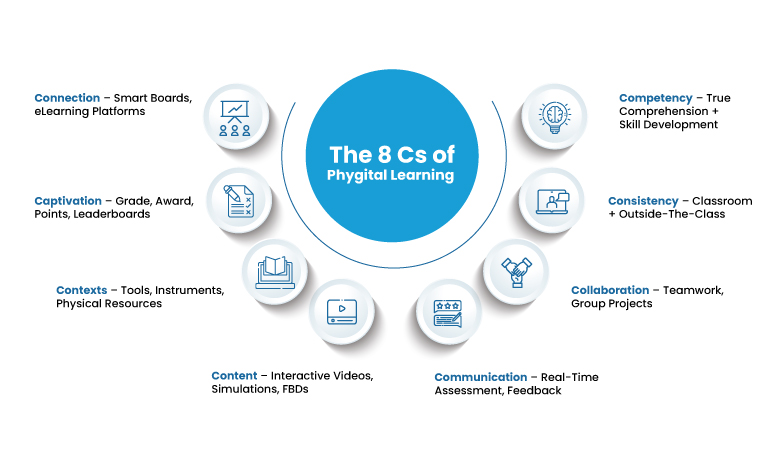
Together, these elements create a smart learning ecosystem designed to support deep learning in STEM education.
1. Connection
Connection is the foundation of Phygital Learning. Students connect to learning platforms through personal or institutional devices using reliable internet access. Learning management systems, smart boards, and mobile devices become extensions of the classroom.
This connectivity ensures uninterrupted access to learning materials, assessments, and feedback—both inside and outside the classroom.
2. Captivation
STEM subjects can often feel intimidating. Captivation ensures learners remain engaged and motivated.
Interactive simulations, visual problem-solving tools, and structured challenges make abstract concepts easier to understand. Engagement is driven by meaningful interaction rather than superficial gamification.
3. Contexts
Contextual learning is critical in STEM education.
Phygital Learning integrates physical tools—such as lab equipment, datasets, engineering models, or real-world case studies—with digital overlays. This contextual approach strengthens conceptual understanding and improves practical application.
4. Content
Content quality defines learning outcomes.
In Phygital Learning, digital content is designed around micro-learning objectives. Interactive videos, simulations, and adaptive problem sets focus on clarity, relevance, and alignment with curriculum goals.
This approach supports technology-enabled innovation in STEM education by enabling experimentation, visualization, and inquiry-based learning.
5. Communication
Two-way communication is essential for learning effectiveness.
Phygital Learning environments enable continuous interaction between students and educators through real-time feedback, in-line questions, and discussion tools. This feedback loop helps students correct misconceptions early and build confidence.
6. Collaboration
STEM challenges are rarely solved in isolation.
Phygital Learning promotes collaboration through group projects, shared problem-solving sessions, and peer discussions. Students learn to articulate ideas, evaluate solutions, and co-create knowledge.
7. Consistency
Learning improves through repetition and reinforcement.
Phygital Learning ensures consistency by linking classroom instruction with digital practice. Students revisit concepts regularly, strengthening retention and skill development over time.
8. Competency
Competency is the ultimate outcome.
Through iterative learning, self-evaluation, and guided practice, students develop higher-order thinking, analytical reasoning, and problem-solving skills—core outcomes of effective STEM education.
Implementing PHYGITAL Learning: Turning Strategy into Practice
Implementing Phygital Learning requires more than adopting digital tools. It demands institutional alignment across pedagogy, infrastructure, and assessment.
1. Educator Readiness and Training
Teachers play a central role in Phygital Learning.
Educators must be trained not only to use digital tools but also to design learning experiences that integrate physical and digital elements seamlessly. Continuous professional development ensures confidence and consistency in delivery.
2. Infrastructure and Connectivity
Reliable infrastructure is non-negotiable.
Institutions must invest in stable internet connectivity, compatible devices, and secure platforms. Without this foundation, the effectiveness of Phygital Learning in STEM education is compromised.
3. Content Development and Alignment
Digital content should complement classroom instruction, not duplicate it.
Collaborative content creation involving subject experts, instructional designers, and technologists ensures alignment with learning objectives and real-world applications.
4. Digital Assessment and Feedback
Assessment models must evolve alongside instruction.
Phygital Learning relies heavily on digital assessment, including interactive quizzes, algorithmically generated questions, and adaptive tests. These methods provide deeper insights into student understanding and support personalized learning pathways.
Modern assessment strategies increasingly depend on smart assessment and automated grading to ensure scalability, consistency, and timely feedback in STEM education.
Academic integrity is equally important. Secure evaluation environments often rely on remote proctoring solutions to maintain credibility without limiting access.
Möbius: Powering Scalable Phygital Learning in STEM Education
In the evolving ecosystem of STEM education, the Möbius platform by DigitalEd India plays a crucial role in enabling Phygital Learning at scale.
1. Interactive STEM Course Design
Möbius allows educators to design interactive STEM courses using simulations, symbolic mathematics, and dynamic problem sets. These tools help students move beyond memorization toward conceptual mastery.
2. Global Collaboration
Geographical barriers dissolve in Phygital Learning environments.
Möbius enables educators and students to collaborate across institutions and regions, fostering shared learning communities. This vision aligns closely with unlocking the potential of India’s future STEM learners.
3. Advanced Digital Assessments
Möbius supports multiple assessment pathways, including adaptive testing, in-line questions, and randomized problem generation. These features enhance fairness while supporting personalized learning journeys.
4. Personalized Learning and Analytics
Every learner progresses differently.
Möbius leverages analytics to identify learning gaps and provide targeted feedback. Educators gain actionable insights, enabling timely interventions and improved learning outcomes.
5. Bridging Knowledge Gaps
By identifying misconceptions early, Möbius helps close knowledge gaps before they widen. This data-driven approach ensures deeper conceptual understanding across STEM disciplines.
Why PHYGITAL Learning Is the Future of STEM Education
Phygital Learning is no longer experimental. It is becoming essential.
For STEM education, it offers structure, flexibility, and depth. It combines the strengths of physical classrooms with the scalability of digital platforms. It supports accessibility, equity, and academic rigor simultaneously.
As institutions prepare learners for increasingly complex scientific and technological challenges, Phygital Learning provides a future-ready framework that aligns with both educational goals and workforce demands.
To explore how Phygital Learning can be implemented effectively in your institution, you can schedule a demo with DigitalEd India.