Why Indian Engineering Faculties Are Burning Out — And How the Right Digital Tool Fixes It
Teacher burnout and unmanageable faculty workload are quietly hollowing out India’s engineering colleges. The crisis isn’t in classrooms. It’s in the hours no one counts.
There is a particular kind of exhaustion that doesn’t show up in medical reports or exit interviews. It lives in the in-between hours — the Sunday evenings spent building question banks from scratch, the exam weeks drowning in identical spreadsheets, the gnawing guilt of knowing your students deserve faster feedback than you can humanly provide. Teacher burnout, in India’s engineering colleges, rarely announces itself loudly. It accumulates. And across the country’s 3,600-plus institutions, this invisible labour has become the norm, costing the system dearly.
India produces more engineering graduates annually than any other nation. Over 1.5 million engineers enter the workforce each year. Behind that number stands a faculty force of roughly 7.2 lakh teachers — many of them overstretched, under-resourced, and increasingly asking themselves how long they can keep going at this pace. The faculty workload in Indian higher education has grown faster than any structural support to manage it.
73% of engineering faculty report moderate-to-severe administrative overload (AICTE Survey, 2024). The average faculty member spends 11 hours every week on manual assessment tasks alone. And 42% are actively considering leaving academia within five years (NIRF Feedback Study, 2024–25).
These aren’t abstract numbers. They are the aggregate cost of a system that asks its educators to simultaneously teach, design assessments, grade at scale, track individual performance, answer queries, prepare accreditation documentation, and contribute to research — often without meaningful digital assistance. Teacher workload management has effectively been outsourced to individual willpower. The burnout isn’t a personality failure. It’s a systemic design failure.
“We spend more time building the infrastructure of learning than we do on the learning itself. Something has broken in the equation.”
— Head of Engineering, Tier-II Autonomous College, Maharashtra
The Numbers India’s Higher Education System Cannot Ignore
The 2024–25 All India Survey on Higher Education (AISHE) paints a portrait of a system under structural pressure — and the challenges in higher education have never been more quantifiable. India now has over 1,113 universities, 43,796 colleges, and 11,860 standalone institutions — with engineering and technology remaining the single largest discipline cluster in terms of enrolment. Student-to-faculty ratios in engineering, which AICTE recommends at 15:1 for core branches, routinely breach 25:1 or higher at many institutions outside the top tiers.
The problems faced by teachers in colleges extend well beyond classroom fatigue. In a typical semester, an engineering faculty member handles between 80 and 140 students across multiple sections. Each student requires regular formative quizzes, mid-semester tests, assignments, and end-semester evaluations. Manual paper-setting is time-intensive; manual grading is worse. And the feedback loop — the critical signal that tells a student where they are going wrong — frequently arrives too late to matter.
Meanwhile, NAAC and NBA accreditation demands have intensified. Outcome-Based Education (OBE) frameworks require institutions to demonstrate measurable course outcomes (COs) and programme outcomes (POs) — which means tracking, documentation, and analytics that most faculty are doing inside Excel sheets at midnight. This is the quiet crisis.
Why Standard Digital Tools for Teachers Have Failed Engineering Faculty So Far
India has not been short of EdTech ambition. Between 2020 and 2024, the country saw over $4.6 billion in EdTech investment. Yet the vast majority of those tools targeted K–12 students or corporate upskilling. For STEM higher education faculty — people who need to write adaptive mathematical assessments, deploy auto-graded calculus problems, and get granular analytics on a class of 120 — the technology in education landscape offered very little that actually worked.
The tools that exist broadly fall into two traps. The first is LMS platforms designed for content delivery — useful for uploading PDFs and recording attendance, but entirely passive when it comes to assessment. The second trap is generic online teaching tools for teachers that cannot render equations, handle symbolic math inputs, or provide anything beyond multiple-choice. For a Differential Equations professor or a Circuits instructor, these tools are not just inadequate — they actively increase workload because of the workarounds they demand.
There is a third trap, less discussed but equally damaging: tools that solve one problem but ignore the whole. A faculty member who can auto-grade quizzes but still manually transcribes those grades into an outcomes mapping sheet, then separately compiles reports for accreditation, has not had their real burden reduced. They’ve had one link in the chain automated while the chain itself remains broken.
Enter Möbius: DigitalEd’s Technology Solution for Education Built Specifically for STEM
DigitalEd is a global ed-tech company with a singular, disciplined focus: STEM higher education. Not K–12. Not corporate training. Not general humanities. Their platform, Möbius, was engineered from the ground up to handle the specific complexity of university-level STEM pedagogy — representing one of the most complete technology solutions for education that Indian engineering institutions can actually deploy at scale.
At its core, Möbius is a fully integrated authoring, assessment, and analytics platform. The automation in education it brings to bear is not superficial — it doesn’t merely digitise paper-based processes. It eliminates entire categories of manual work that have historically consumed faculty time without improving student outcomes.
Adaptive Question Engine
Faculty author a question once and Möbius generates thousands of algorithmically randomised variants from that single template. No two students receive the same paper, eliminating copying without compromising fairness. A single well-designed question becomes an assessment infrastructure — usable across batches, semesters, and years.
Symbolic Math Auto-Grading
Students type mathematical expressions — derivatives, integrals, matrices, differential equations — and Möbius grades them with full symbolic accuracy. This is not pattern-matching or keyword detection. It is actual mathematical evaluation, achieving 98.6% grading accuracy on STEM assessments. For the first time, a faculty member can assign a calculus problem set to 120 students and have every response graded before the next class begins.
Real-Time Performance Dashboards
Faculty see — live, during an assessment — which concepts a class is struggling with, which students are at risk, and where a question itself may be poorly calibrated. This transforms the post-exam debrief from a retrospective ritual into a timely intervention. The data arrives when it can still change outcomes, not after the semester has moved on.
OBE and Accreditation Mapping
Every question, every assessment, and every result is automatically mapped to Course Outcomes and Programme Outcomes from the moment of creation. NAAC and NBA documentation — a process that currently consumes weeks of faculty time each cycle — becomes a scheduled report export. What was a project becomes an administrative task measured in minutes.
Verified STEM Question Bank
Möbius comes with over 30,000 peer-reviewed, discipline-specific questions across engineering mathematics, physics, circuits, mechanics, and more. Faculty don’t start from zero. They adapt what already exists, reducing question design time by up to 80% on first use and eliminating it almost entirely in subsequent semesters.
LMS Integration via LTI 1.3
Möbius connects seamlessly with existing university LMS platforms through the LTI 1.3 standard. There is no rip-and-replace, no migration project, no institutional disruption. Faculty keep their familiar environment. Möbius adds the STEM assessment layer that was always missing from it.
What makes Möbius different is not any single feature — it is the integration of all of them into a workflow that reduces faculty administrative time rather than redistributing it. The platform was designed with a clear-eyed understanding of what university STEM teaching actually looks like from the inside.
What This Means for Faculty Time: The Arithmetic of Relief
An engineering faculty member in India, teaching two courses to 100 students each, currently spends significant hours each semester on tasks that Möbius either eliminates or dramatically compresses:
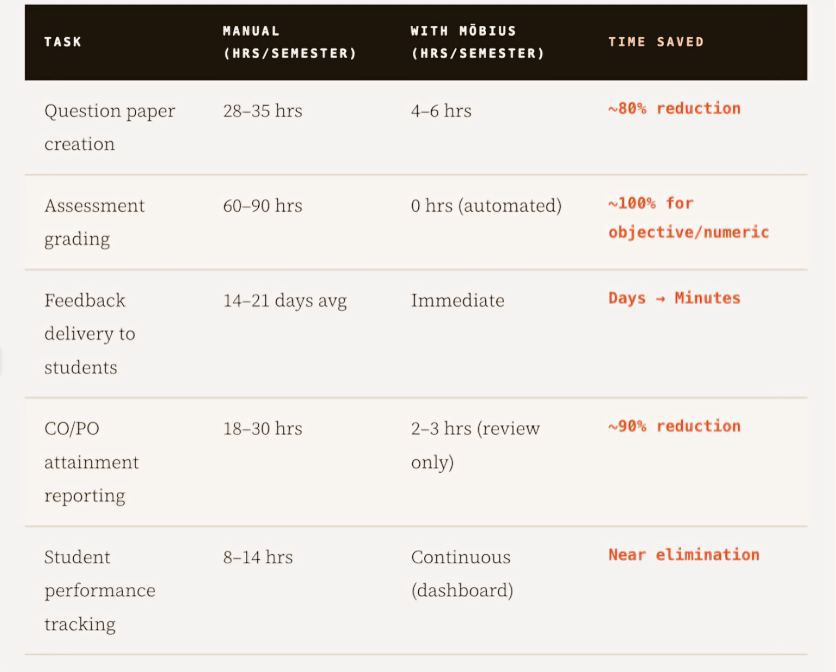
Across a single academic year, a faculty member using Möbius can reclaim an estimated 130–180 hours of administrative time. That is not a rounding error. That is the equivalent of four full working weeks — time that can return to research, to better lecture preparation, to mentoring students, or simply to rest. To a profession staring at a retention crisis, those hours are the difference between staying and leaving.
The Student Side of the Equation
Teacher burnout conversations tend to focus on faculty — rightly so. But the same system that grinds educators down also shortchanges students. When feedback takes two weeks to arrive, a student has already moved three chapters forward, building on foundations they don’t realise are shaky. When every student in a batch receives the same question set, assessment ceases to measure learning and begins measuring collaboration.
Möbius shifts this dynamic directly. Algorithmically varied questions mean genuine individual assessment. Instant feedback — including worked solutions and explanatory hints — means students understand their mistakes in the same session they make them. For a first-year engineering student in Tier-II India who may not have a family member who can explain why their circuit analysis went wrong, that immediate, intelligent response is not a convenience. It is access.
In one documented deployment at a technical university in South India, first-year pass rates in Engineering Mathematics improved by 19 percentage points over two semesters following the adoption of Möbius for formative assessment. Faculty attributed the improvement not to teaching more, but to teaching more precisely — guided by real-time data on exactly where the class was losing the thread.
The Institutional Case: Accreditation Without the Annual Nightmare
For Heads of Department and Deans across India’s autonomous colleges and deemed universities, the Möbius value proposition has a second dimension entirely: accreditation readiness. NAAC assessments and NBA accreditation cycles demand exhaustive evidence of OBE implementation — and the documentation burden falls squarely on faculty who are already stretched thin.
Möbius maps every assessment to institutional outcome frameworks from the moment of creation. Attainment computations — the notoriously time-consuming process of aggregating student performance against defined COs and POs — are generated automatically at the end of each assessment and compiled into reports that institutions can directly present to accreditation bodies. What was a semester-long data aggregation exercise becomes a scheduled export.
In a higher education landscape where NAAC accreditation directly affects funding, rankings, and the institution’s ability to attract faculty and students, this operational efficiency is not administrative convenience — it is strategic advantage.
Addressing the Resistance: Is This Just Another Digital Tool for Teachers That Demands More?
A fair question — and one that surfaces in every faculty room where EdTech is discussed. The institutional graveyard of platforms adopted with fanfare, used for one semester, and quietly abandoned is well-populated. Every new system asks for onboarding time, creates a learning curve, and risks becoming one more tab in an already crowded browser. Most digital tools for teachers in higher education have failed this test — they solve narrow problems while creating new friction elsewhere.
DigitalEd India has built Möbius with this history in mind. The platform’s authoring interface was designed to feel closer to a word processor than a coding environment. Faculty without any prior EdTech experience can build and deploy their first adaptive quiz within a working day. The question bank means they don’t have to start from zero — they adapt what already exists. The LTI integration means they don’t have to move their students out of familiar systems.
More substantively: the adoption cost is front-loaded and the returns compound. A faculty member who builds a question bank for Engineering Mathematics in Semester 1 deploys a variant of it in Semester 3, and again in Semester 5. The authoring investment made once pays dividends across every subsequent batch. That is structurally opposite to the manual model, where every semester starts from scratch.
The Choice Is No Longer About Technology
India’s engineering education system stands at an inflection point. The demand side is growing — more students, higher expectations, sharper industry requirements. The supply side is under pressure — fewer incoming faculty, rising attrition, mounting administrative burden. Teacher burnout is not a soft HR problem. It is a structural threat to the quality of higher education in India.
The institutions that will navigate this transition successfully will be those that understand the difference between digitising existing processes and actually redesigning the workflow. Effective teacher workload management requires platforms purpose-built for STEM — not adapted from tools designed for other contexts. Möbius, built by DigitalEd for exactly this purpose, uses automation in education thoughtfully: removing work that should never have been manual, freeing faculty to focus on what only a human teacher can do.
The problems faced by teachers in colleges — assessment overload, documentation burden, delayed feedback cycles — are solvable. The challenges in higher education are not permanent features of the landscape. They are design problems. And Möbius is the design solution.